2. Limbo, the self and photography
Exploration of Hélène Amouzou

Hélène Amouzou: A refugee from Togo, Amouzou’s work explores the migrant, asylum-seeker, and undocumented status. Living in limbo, separated from her husband in 1992, Amouzou was forced to leave Togo due to political unrest and protests. Leaving Togo to Benin with her husband and daughter, from Benin, Amouzou applied for asylum in Germany but were denied entry after discovering their names were on a deportation list. This is suspect to be due to her husband’s political associations. After her husband attended his registration appointment, he never returned and Hélène and her daughter went into hiding. For almost 20 years, Amouzou lived with no immigration status. Not belonging to any nation or country, this reshaped her understanding of her self and the world. Photography became a way of reconciling these new found relations and a means of escaping the conditions she was forced to live in. Working primarily with film, her photographs act as bridges to a lost world, a lost time, that veil a level of safety that is knowingly nonexistent. A hope to repair something that has been lost, there is a feeling of nostalgia that reflects in her work that lives in its own limbo.
“Revealing yourself to others is never easy. For me, self-portraiture was a way to free myself from the weight of exile and to externalise certain thoughts without using words or making noise.”
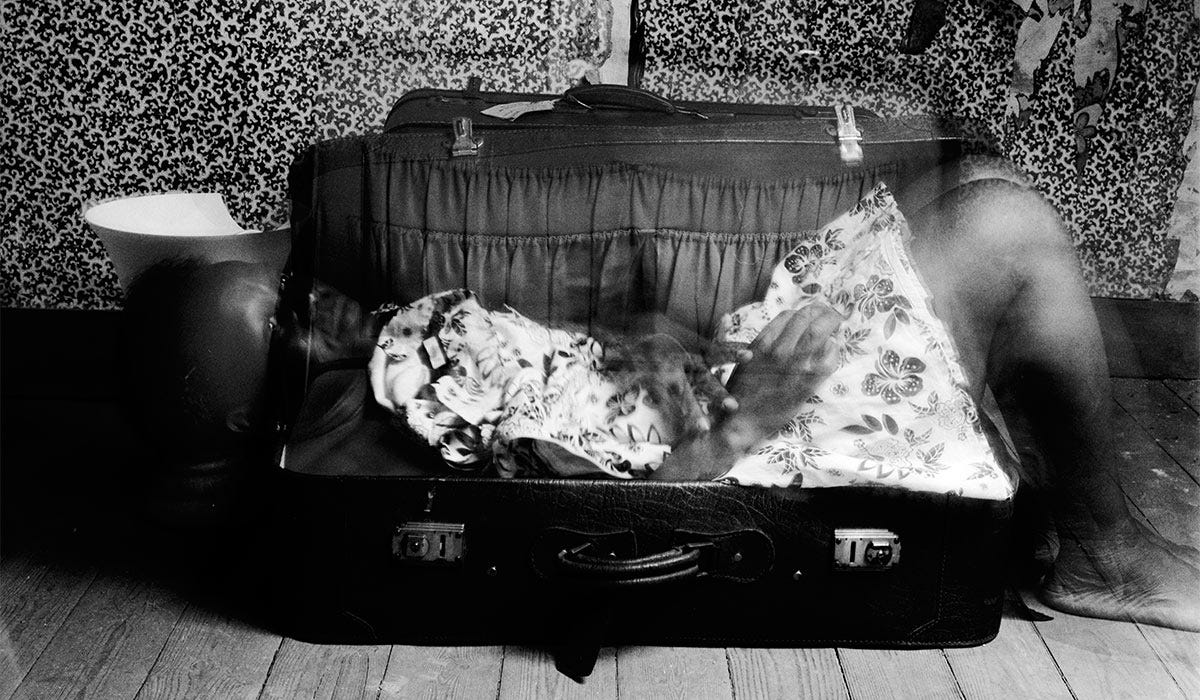
The series ‘the attic’ is quite impactful and captures the culmination and intersections of this journey. Taken in the attic of her first apartment in Belgium that her and her daughter lived in, Amouzou saw the space as one that suited her as it was an “unoccupied space with a past.” In this urgency for home, the series operates as a reconstruction of a past. An improvised, makeshift, reality that could take place in the attic. A dream space as Amouzou describes it, the allowed her to make her images a reality and reconstruct and re-identify with home. The warmth in these black and white images come from the familiarity of objects despite her and the attic holding different stories. They are two spaces of the self and the space seeking companionship, with couches and suitcases that hold lost possessions. The items do not seem as important than the way the body is positioned around them in her photos. Grasping and relaxing into the materials. The blurriness of the figure demonstrates this impermanence and liminal space of crossing. That the attic is a place of temporary safety, comfort, and a room for home, but one she will eventually leave. A transition space before the next move. The timeless feeling of the photos yet the time immediate recognition of their significance creates a powerful and provocative image that challenges our notion of the self, possession, longing, and home. What can an image capture and what is the role of precarious memory in constructing our identities? Who are we when the world cannot locate us or claim our bodies to a nation, to an immigration status? How are we still valued and loved? The series seems to be a narrative of rediscovering her self in the face of these questions. Seeking refuge in a small room and configuring her stories amongst the others that exist in that attic to never be known, but recognize they occurred and exist. The attic becomes a new space of belonging of lost and found stories of refuge and incomplete selves that can reconcile each other in a beautiful temperament.